The odds and payouts are slightly different for each wheel type, and are listed below. If you are looking for professional roulette systems that work, visit the www.roulettephysics.com home page.
Roulette Odds and Payouts
| Bet | Payout | European Roulette Odds (Chance of Winning) | European Roulette House Edge | American Roulette Odds (Chance of Winning) | American Roulette House Edge |
| Reds / Blacks (colour) | 1:1 | 48.65% | 2.7% | 47.37% | 5.26% |
| Evens / Odds | 1:1 | 48.65% | 2.7% | 47.37% | 5.26% |
| Lows / Highs (1-18 / 19-36) | 1:1 | 48.65% | 2.7% | 47.37% | 5.26% |
| Dozens | 2:1 | 32.43% | 2.7% | 31.58% | 5.26% |
| Columns | 2:1 | 32.43% | 2.7% | 31.58% | 5.26% |
| 6 Numbers (6 line) | 5:1 | 16.22% | 2.7% | 15.79% | 5.26% |
| 5 Numbers (top line) | 6:1 | – | – | 13.16% | 7.89% |
| 4 Numbers (square) | 8:1 | 10.81% | 2.7% | 10.53% | 5.26% |
| 3 Numbers (street) | 11:1 | 8.11% | 2.7% | 7.89% | 5.26% |
| 2 Numbers (split) | 17:1 | 5.41% | 2.7% | 5.26% | 5.26% |
| 1 Number (straight) | 35:1 | 2.70% | 2.7% | 2.63% | 5.26% |
| |||||
The roulette betting calculators available online also compute high-risk betting units, suitable for the type of player, who prefers to bet big and collect greater profits, respectively. The roulette betting calculator has computed a high-risk betting unit of £8 for the bankroll of £200, used in this example.
Types Of Roulette Bets:
The two main types of bets are “inside” and “outside”. There are different betting limits for each type of bet. Usually you can bet much higher on outside bets. This is for a few reasons, but mainly because the payouts are much higher on inside bets.
The Types of Roulette Bets, Roulette Odds and Chip Placement
(1) Straight (1 number): 35-1 payout (pays your original bet PLUS 35 units). The example covers number 2.
(2) Split (2 numbers): 17-1 payout (pays your original bet PLUS 17 units). The example covers numbers 2 & 6.
(3) Street (3 numbers): 11-1 payout (pays your original bet PLUS 11 units). The example covers 7, 8 & 9.
(4) Square (4 numbers): 8-1 payout (pays your original bet PLUS 8 units). The example covers 8, 9, 11 & 12.
(5) Six Line (6 numbers): 5-1 payout (pays your original bet PLUS 5 units). The example covers numbers 13, 14, 15, 16, 17 & 18.
(6) Colours (18 numbers): 1:1 payout (pays your original bet PLUS 1 unit). The example covers all black numbers.
(7) Dozens (12 Numbers): 2-1 payout (pays your original bet PLUS 2 units). The example covers numbers 13 to 24 (the second dozen).
(8) Highs / Lows (1-18 or 19-36): 1-1 payout (pays your original bet PLUS 1 unit). The example covers numbers 19 to 36.
(9) Odds/Evens (18 numbers): 1-1 payout (pays your original bet PLUS 1 unit). The example covers all odd numbers.
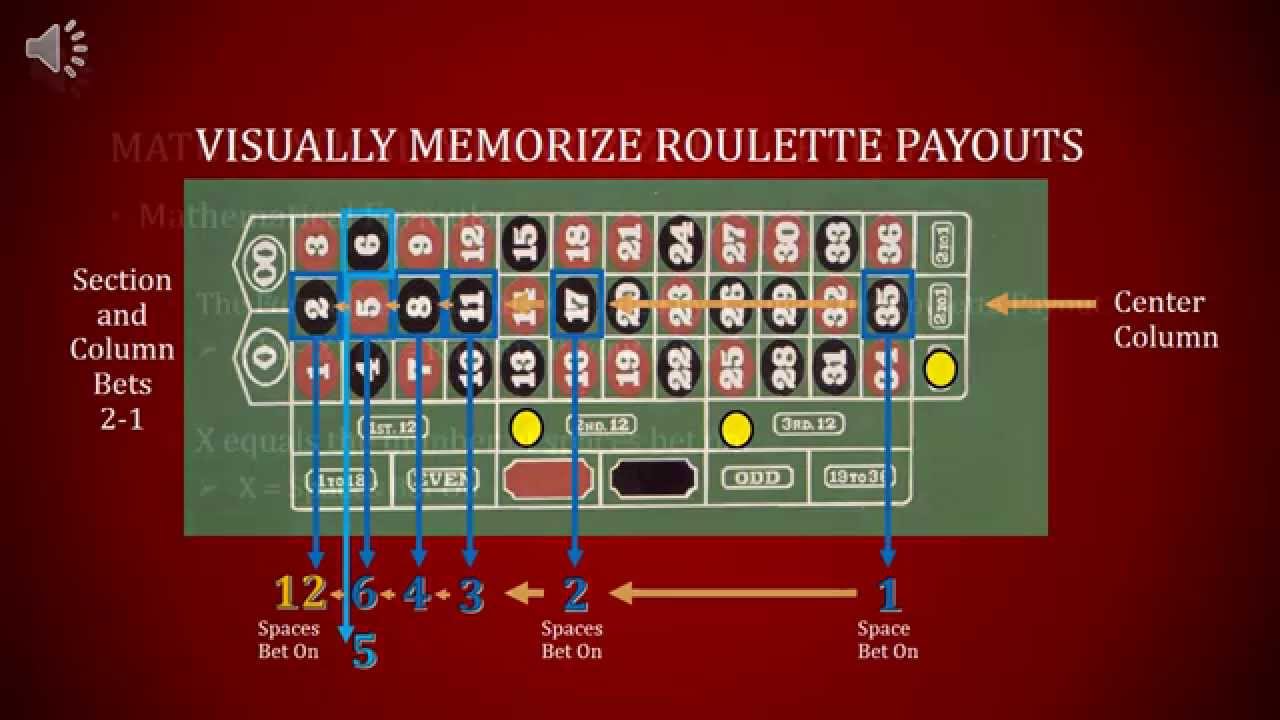
(10) Columns (12 numbers): 2-1 payout (pays your original bet PLUS 2 units). The example covers numbers 2, 5, 8, 11, 14, 17, 20, 23, 26, 29, 32, 35.
Avoiding Common Misconceptions
One of the most common mistakes a roulette player will make is to increase bets after losses, without any consideration to predicting the winning number. It should be obvious that roulette is all about the winning number. And the idea is to bet on the winning number. But almost every roulette system does not even consider why the ball lands where it does. It sounds ridiculous but it’s true. The average roulette bet made by players don’t even consider variables that determine where the ball will land.
For example, a simple system may be to bet on red but increase your bet size after a loss. The theory is that increasing the bet size will allow you to win back any losses. But the reality is you are simply increasing the amount you wager on the next spin. Each spin has no correlation to the following spin, at least not in the way that such a betting system assumes.
Another example is consider 10 reds spinning in a row. One roulette player says “red is on a streak, I must bet red”. Another player says “black is due to spin next, so I’ll bet black”. So who is right? Neither of them. This is because the odds of red or black spinning are still 50/50 (neglecting the existence of zero for now). It’s amazing how every player at the table things either one way or the other when there is a long streak of a particular colour. Meanwhile the casino owner is sitting back rubbing their hands, grateful that the players have no idea that the illusion of streaks or due events is all in the player’s head.
Race Track Bets
Not all roulette tables offer race track bets. The race track enables players to make bets based on specific segments of the roulette wheel. The rules for use of the race track vary between casinos. Also the wording sometimes varies between race tracks, although usually the same areas for bets are available.
Series 5/8: A bet on the orange “Series 5/8” area is the following:
Splits (2 numbers): 5 & 8, 10 & 11, 13 & 16, 23 & 24, 27 & 30, 33 & 36
Orphelins: A bet on the green “Orphelins” area is:
Straight (1 number): 1
Splits (2 numbers): 6 & 9, 14 & 17, 17 & 20, 31 & 34
Series 0/2/3: A bet on the orange “Series 0/2/3” area is:
Streets (3 numbers): 0, 2, 3
Splits (2 numbers): 4 & 7, 12 & 15, 18 & 21, 19 & 22, 25 & 28, 26 & 29, 32 & 35.
0-Game: A bet on “0-Game” is:
Straight (1 number): 26
Splits (2 numbers): 0 & 3, 12 & 15, 32 & 35
Neighbor bets: This is a bet on a single number on the race track. If you bet in a real casino, one bet on an number splits the bet amount between 5 numbers. This includes the number you’ve bet, plus the 2 numbers each side of it. If you bet in an online casino, a click on an individual number automatically places one chip on the number, plus one chip on each of the 2 numbers on each side (total 5 numbers and 5 chips).
In some casinos, neighbor bets must be passed to the dealer, who may then inform the pitt boss of your bet. The reasons behind this are varied. Firstly, it helps detect professional players who bet on sectors. And secondly, it makes your bet clear to everyone so there are no misunderstandings. Any misunderstandings about where players wanted to bet would otherwise cause arguments.
What’s The Best Roulette Bet?
The best bet is wherever the ball lands. Duh, right? But let me explain more . . . Firstly, realistically you can’t know exactly what number will win on every spin. But on most wheels, it is at least possible to predict which area the ball will bounce to, and you can have at least better than random accuracy. You need to understand the house edge with roulette is only small, and you only need to have slight accuracy of predictions to put the edge in your favor. You’d think it would be impossible to predict where the ball bounces, and you’d think the dealer’s spin speeds would control it all. But take your time to read this website and understand the principles that make roulette a much more predictable game than you may think.
How Important are Roulette Odds?
Roulette Winning Numbers
The roulette odds simply tell you how often you can expect to win if the accuracy of your bet selection is no better than random. If you apply advantage play methods that use physics to predict the winning number, then the odds change, although generally the player edge becomes the focus.
For example, the odds of winning on a European roulette wheel are 1 in 37 if you bet on a single number. But with a roulette computer device, you could win as often as 1 in 10 spins. So you will have more than tripled your odds of winning, making the typical roulette odds somewhat irrelevant.
Which Bets Have the Best Odds?
The “best odds” of winning is different to the payout and edge. You could bet on every number, and you’d win every time, so your odds of selecting the winning number would be highest. But you’d still actually lose money because you’d be paid an unfair amount. This unfair amount is the “house edge”. So instead of considering the “best odds in roulette”, consider the “house edge”. But as per the above chart, the edge is the same on all bets.
European and American Double 0 Wheel Layouts
The American wheel has both single and double 0 pockets, whereas the European wheel only has a single green 0. The layout of each wheel type is below:
Single-zero (European) wheel: 0,32,15,19,4,21,2,25,17,34,6,27,13,36,11,30,8,23,10,5,24,16,33,1,20,14,31,9,22,18,29,7,28,12,35,3,26
Double-zero (American) wheel: 0,28,9,26,30,11,7,20,32,17,5,22,34,15,3,24,36,13,1,00,27,10,25,29,12,8,19,31,18,6,21,33,16,4,23,35,14,2
The House Edge
The house edge is the normal edge the casino has over players. On the European wheel, it is -2.7% and on the American wheel, it is -5.26%. So the advantage the casino has over players is much greater with the American wheel. However, in either case it’s still only a minor advantage the casino has. But unless the accuracy of the player’s predictions is better than random, this small edge is enough for the casino to reliably profit over the long term. It is inevitable that some players will win in the short-term, but the casino thinks in terms of tens of thousands of spins and thousands of players, not individual players. The only time casinos consider individual players is if they appear to be using a professional roulette system.
Call Bets
Called or announced bets are bets that are made by speaking them, without actually placing the bets. These type of bets are not permitted in all jurisdictions, mostly because it creates opportunities for cheating players to place bets without having any money.
Neighbor Bets
These are typically used by professional players to bet on particular physical sectors of the roulette wheel. Sector bets are the only types of bets that increase the roulette odds for you. For example, a neighbor bet on zero for the European roulette wheel will typically cover numbers 3,26,0,32,15. This is because sector based bets are used in advantage play methods. In particularly the European casinos, a neighbor bet must be given to the dealer, who then announces the bet to the pit boss. From a professional player’s perspective, it is not wise to do this too often as it attracts attention. Neighbor bets are placed on a circular representation of the wheel situated on the betting table, called the race track.
For the most part, calculating roulette payouts is just a matter of multiplication. Each bet pays out at certain odds, and that determines what you multiply the bet by to get the payout. Also, as with most table games, the payouts are done on an X to Y basis, as opposed to an X for Y basis.
This post wants to cover roulette payouts in some degree of detail, though, including how much each bet pays off.
More importantly, I want to explain how the croupier is able to calculate payouts for roulette so quickly. Guess what? They have a system for that.
Payout Odds in Gambling
When you’re gambling on something, you get paid off using odds. Some games offer even odds, which means that if you bet $100, you win $100 when you win.
Most games, though, have various payouts for various kinds of bets.
The top jackpot on a video poker machine pays off at 800 for 1.
And that’s an important distinction. There’s a big difference between a payoff of 800 for 1 and a payoff of 800 to 1.
With table games like roulette, the payoffs are in the form of 2 to 1, 3 to 1, 35 to 1, etc.
This means that if you win the bet, you get to keep the amount you bet, and you get the winnings along with it.
If you bet $100 on a single number at the roulette table and win, you get a payoff of $3,500. But you also get to keep your $100.
With gambling machines, payouts are made on a “for” basis instead of a “to” basis. This means your winnings are traded for what you risked.
If you bet $5 on a slot machine and win a $10 payout, you don’t get your $5 back on top of that.
This is an important distinction you should make. Most gamblers don’t stick just with roulette, so if you’re going to play other games — and you probably will — you should understand how that works.
Specific Payouts in the Game of Roulette
In roulette, you have a huge variety of bets you can place. You bet on a single number. Or you can bet on two numbers — if either of those numbers come up, you win. Or you can bet on three numbers, and if any of those three numbers come up, you win.
The more likely it is for you to win, the lower the payout is.
A bet on black wins almost half the time. The payoff for that bet is only 1 to 1, or even money.
A bet on a single number pays off at 35 to 1, which is a big payoff, but it also only wins 1 out of every 38 spins on average.
The Difference Between the Odds of Winning and the Payout Odds

The casino makes its money from the difference between the odds of winning and the payout odds.
You know how you can express the payout on a bet as odds?
35 to 1 is an example of how you’d express a payoff on the single number bet.
The odds of winning can also be expressed in the same way.
On a standard American roulette wheel, you have 37 ways to lose a single number bet and only one way to win.
This means the odds of winning are 37 to 1.
Probability Of Winning Roulette
Since the odds of winning are lower than the payoff for the bet, the casino makes a profit in the long run.
Once out of every 38 spins, they’ll pay off a single number bet, but they’ll only pay off 35 to 1 on that bet. The rest of the money goes into the casino’s pocket.
The casino deals in long-term averages, especially when it comes to roulette.

Roulette Bets and Their Payoffs
Here’s a list of bets you can make at the roulette table and how much each of them pays off.
The Outside Bets
These are the bets on the outside of the betting surface, and they’re the bets that pay off the most often. As a result, you win less with these bets.
How To Calculate Roulette Winnings In Florida
Here are the outside bets you can make:
- Red(or Black) – You can bet on the color of the number, and the payout is even money — 1 to 1
- Even (or Odd) – You can bet that the number will be even or odd, and the payout is again even money — 1 to 1
- Low (or High) – You can bet that the number will be 1-18 (low) or 19-36 (high). The payout is even money on this one, too
- Columns – The numbers on the betting surface are organized into three columns. You can bet that the ball will land on one of the numbers in that column. The payoff, if you guess right, is 2 to 1
- Dozens – The numbers can be divided into 1st third (1-12), 2nd third (13-24), and 3rd third (25-36). If you guess right, you get a 2 to 1 payout
On all these outside bets, 0 and 00 count as losses. Those numbers are green, and they’re not considered even or odd, high or low.
The Inside Bets
These are the bets on the inside of the betting surface. They pay out better but have a bigger chance of losing.
Here are the inside bets you can make:
- Straight Up – This is a bet on a single number and pays off at 35 to 1
- Split – This is a bet on two numbers that are next to each other. It pays off at 17 to 1
- Street – This is a bet on three numbers, and it pays off at 11 to 1
- Corners – This is a bet on four numbers, and it pays off at 8 to 1
- The 5-Number Bet – You can only bet on 0, 00, 1, 2, and 3 if you want to bet on five numbers, and it pays off at 6 to 1. This is the only bet on the roulette table with a different house edge from the other bets — 7.89% (the other bets have a house edge of 5.26%)
- Line – This is a bet on six numbers and pays off at 5 to 1
All these bets would be a break-even proposition in the long run IF the wheel didn’t have a green 0 and a green 00.
How the Croupier Makes the Payouts So Quickly
The first thing the croupier does after the decision is to clear all the losing bets off the roulette table. Since he’s intimately familiar with the layout of the betting surface, this doesn’t take long at all.
Also, all the players at the roulette table have chips that are specifically colored so that they have the same color. You can’t use the roulette chips at the other table. This enables the croupier to tell your bet from someone else’s. It’s the color of the chips.
To calculate the payouts, you just multiply the bet by the payout odds.
If someone bet two chips on a single number and it won, you’d multiply 2 by 35 and get 70. That’s how many chips you’d give the player in winnings.
He doesn’t really have a magical system, either. He knows the payouts for the various bets, and he’s able to do the multiplication in his head. It’s easy multiplication, but even if it weren’t, he’d eventually just be able to memorize the correct payout relative to the number of chips bet.
Also, he doesn’t really think of the chips as money. They’re just betting units.
Can Any of This Information Help Me Win at Roulette?
Naw.
Roulette’s a negative expectation game.
You might get lucky in the short run, but if you play long enough, the math behind the payouts will eventually reduce your bankroll to 0.
Conclusion
And that’s how to calculate roulette payouts. You just memorize which bets are possible and how much they pay off. Once you know that, calculating the payouts is just a matter of multiplication.
Croupiers are able to do it quickly because they do it all day every day.
I’m able to make change in my head because I worked for years on cash registers that didn’t calculate change. I know how to subtract from 100 without any effort at all.
How To Calculate Roulette Winnings 2017
Calculating roulette payouts is a similar skill.
Please enable JavaScript to view the comments powered by Disqus.